Fluorescent dyes and antibody–dye conjugates compatible with the SLICE microscope are widely available from commercial life-science suppliers. Achieving optimal performance, however, requires careful selection of fluorescent dyes tailored to the system’s excitation laser and emission filters. For the most up-to-date list on fluorescence channel configurations and compatible dyes/ labels, visit the SLICE-compatible fluorescent dyes and proteins page in the user guide.
The table below lists commonly used dyes and links to vendor websites, including Abcam, Jackson ImmunoResearch, and Thermo Fisher Scientific, where users can search for antibody–dye conjugates. These links are provided for convenience only. Product availability, specifications, and compatibility may vary by antibody type, host species, and conjugation format. Users should review the vendor documentation to confirm suitability for their specific experiment.
Conjugated Antibodies
| SLICE Filter | Dye | Ex. (nm) | Em. (nm) | Abcam | Jackson ImmunoResearch | Thermo Fisher Scientific |
|---|---|---|---|---|---|---|
| Blue narrow/ Blue | Alexa Fluor 488 | 493 | 519 | View product | View product | View product |
| Blue narrow/ Blue | Cy2 | 492 | 510 | View product | View product | – |
| Blue narrow/ Blue | FITC | 492 | 520 | View product | View product | View product |
| Green | Alexa Fluor 555 | 552 | 572 | View product | View product | View product |
| Green | Alexa Fluor 568 | 578 | 603 | View product | View product | View product |
| Green | Cy3 | 550 | 570 | View product | View product | View product |
| Green | PE-Texas Red | 565 | 578 | View product | View product (R-PE) | View product |
| Red | Alexa Fluor 647 | 650 | 668 | View product | View product | View product |
| Red | Alexa Fluor 680 | 679 | 702 | View product | View product | View product |
| Red | Cy5 | 650 | 670 | View product | View product | View product |
For experiments requiring genetically encoded fluorescence, fluorescent reporter mouse lines can be obtained from repositories such as The Jackson Laboratory, and equivalent reagents may be available from other providers.
Fluorescent Reporter Mouse Lines
| SLICE Filter | Dye | Ex. (nm) | Em. (nm) |
|---|---|---|---|
| Blue narrow/ Blue | ECFP | 433 | 475 |
| Blue narrow/ Blue | EGFP | 488 | 507 |
| Blue narrow/ Blue | mNeonGreen | 506 | 517 |
| Blue narrow/ Blue | mTurquoise | 434 | 474 |
| Green | DsRed | 553 | 584 |
| Green | EYFP | 513 | 527 |
| Green | mCherry | 587 | 610 |
| Green | mRuby | 558 | 605 |
| Green | RFP | 555 | 584 |
| Green | tdTomato | 554 | 581 |
| Green | Venus | 515 | 528 |
| Red | iRFP670 | 643 | 670 |
To review the detection efficiency of fluorophores on the SLICE microscope, please refer to SLICE-compatible fluorescent dyes and proteins. For other fluorophores of interest, you can use external fluorescence spectra tools (e.g. FPbase Fluorescence Spectra Viewer and Fluorescence SpectraViewer) to evaluate how effectively a specific dye will perform with the SLICE optical configuration. These tools calculate theoretical signal yield by modeling how the dye interacts with the system’s lasers and bandpass filters as:
- Excitation efficiency: The fraction that an incident photon at a given wavelength will be absorbed by the fluorophore as
 , where
 is molar extinction coefficient of the dye at wavelength
 .
- Emission efficiency: The fraction of the dye’s emission spectrum that passes through the detection filter as
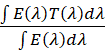 , where
 is normalized emission spectrum of the dye at wavelength and
 is transmission of the bandpass filter at wavelength .
- Detection efficiency: The fraction of incident excitation photons that ultimately produce detectable fluorescence photons within the detection filter bandwidth as multiplication of excitation efficiency and emission efficiency.